UK Crypto Sportsbooks: Best NFL Crypto Betting Sites 2026
 Available in US
Table of Contents
- Crypto Advantages and Real Impact on UK NFL Betting Markets
- What Every UK Bettor Needs to Know Before Kickoff
- The NFL Crypto Betting Market in Numbers
- How NFL Crypto Betting Actually Works
- What Separates a Top-Tier Crypto NFL Sportsbook
- Which Cryptocurrencies Work Best for NFL Bets
- Blockchain Networks Compared: Speed, Fees, and Finality
- UK Regulatory Landscape: What UKGC Says About Crypto
- The NFL’s Growing Footprint in Britain
- NFL Bet Types Available on Crypto Sportsbooks
- Security, Licensing, and Protecting Your Bankroll
- Your First NFL Crypto Bet: A Step-by-Step Walkthrough
- Frequently Asked Questions
- Where Data Meets the Decision
Crypto Advantages and Real Impact on UK NFL Betting Markets
Three years ago, I placed a spread bet on a Thursday Night Football game using Bitcoin. The deposit cleared in forty minutes. By the time the transaction confirmed on-chain, the line had moved a full point against me. I still took the bet — and won — but that night crystallised something I’d been watching for years: crypto and NFL betting were converging fast, and neither the technology nor the platforms had caught up with the demand.
Today, the convergence is no longer theoretical. The crypto gambling market is projected to exceed $65 billion by the end of 2026, and NFL betting alone generated an estimated $30 billion in legal wagers during the 2025 season. Those two numbers are colliding in a space that barely existed a decade ago — and UK bettors sit at a peculiar intersection of both trends.
UK Regulatory Note: As of mid-2026, the UK Gambling Commission does not permit UKGC-licensed operators to accept cryptocurrency as a payment method. UK bettors using crypto for NFL wagers are accessing offshore platforms operating under non-UK licences. This guide covers the landscape as it exists, not as regulators might wish it to be.
Britain accounts for roughly 3% of global NFL fan traffic — a figure that sounds modest until you realise a third of those fans are under 35, the exact demographic driving cryptocurrency adoption. The overlap between people who watch the Super Bowl at 11pm on a Sunday night in London and people who hold USDT in a mobile wallet is not a coincidence. It is a market forming in real time.
This guide exists because most of what ranks for “best NFL crypto betting” is either an affiliate list dressed up as a review or a sportsbook landing page pretending to be editorial content. I have spent over nine years analysing crypto wagering platforms, and the current top ten results collectively fail to address the questions UK bettors actually ask: What does the UKGC’s shifting stance mean for me? Should I bet with Bitcoin or a stablecoin? How do blockchain confirmation times interact with live NFL odds?
What follows is not a rankings list. It is an analytical framework for evaluating crypto NFL sportsbooks, understanding the regulatory terrain, and making informed decisions about which cryptocurrency, which network, and which platform structure best suits your betting profile.
What Every UK Bettor Needs to Know Before Kickoff
- Crypto gambling hit $81 billion in 2025, with stablecoins projected to handle over 70% of all crypto wagers by end of 2026 — making USDT on TRC-20 the most practical default for NFL betting.
- The UKGC does not currently permit licensed operators to accept crypto, but both Tim Miller and Andrew Rhodes signalled a shift in late 2025 and early 2026. The FCA’s cryptoasset regime takes effect October 2027.
- Blockchain network choice matters as much as crypto choice: Lightning Network and TRC-20 settle in seconds at under $1, while Ethereum mainnet fees can exceed $30 during congestion.
- Platform evaluation should prioritise licensing jurisdiction, payout history, and cold-storage practices over bonus percentages or marketing claims.
- The UK’s NFL audience skews younger than in the US, with a third of fans under 35 — the same demographic driving crypto adoption and creating a natural crossover market.
The NFL Crypto Betting Market in Numbers
I keep a spreadsheet of market-size estimates. Not because I enjoy spreadsheets — I do, but that is beside the point — but because the numbers in this sector move so fast that anyone citing a figure from eighteen months ago is already telling you a half-truth. Here is where the market stands right now, based on the most recent data available.
The global sports betting market was valued at $100.9 billion in 2024 and is projected to reach $187.39 billion by 2030 at a compound annual growth rate of 11%. Within that, online sports betting alone accounts for an estimated $53.8 billion in 2025, heading toward $93.3 billion by the end of the decade. These are large, well-documented markets. Crypto is carving an increasingly visible slice.
In 2025, players wagered at least $81 billion through crypto casinos and sportsbooks — a fivefold increase from $16 billion in 2022. Crypto platforms now handle approximately 17% of all iGaming volume worldwide.

That 17% share is worth pausing on. Three years ago, crypto gambling was a niche curiosity. Now it processes roughly one in every six bets placed online globally. The growth is not evenly distributed across sports, though. NFL betting occupies a dominant position in American sports wagering — 60% of US bettors wager on football, and legal NFL bets reached $30 billion in the 2025 season alone. The Super Bowl remains the single largest betting event on the calendar: Americans legally wagered $1.39 billion on Super Bowl LIX in 2025, and the 2026 game drew 124.9 million viewers.
Crypto betting volume in Q1 2025 hit $26 billion — nearly double the same quarter a year earlier. If that pace held through the NFL season, the sport’s share of crypto wagers would represent a substantial portion of the total market.
| Metric | Traditional Online Betting | Crypto Betting |
|---|---|---|
| Global market estimate 2025 | $53.8 billion | $81 billion wagered in 2025 |
| Growth rate | CAGR 11.65% | CAGR 12-15% |
| Share of iGaming | ~83% | ~17% |
| Dominant payment method | Debit card / e-wallet | Stablecoins (USDT, USDC) — 70%+ projected in 2026 |
| NFL-specific volume | $30 billion legal US wagers (2025 season) | Growing but not separately tracked |
Tim Miller, executive director of the UK Gambling Commission, acknowledged the trajectory in February 2026 with a statement that stopped short of endorsement but carried unmistakable momentum: “Demand exists and will probably grow.” That is the closest thing to a green light the UKGC has offered, and it landed in a speech that also outlined the regulator’s interest in exploring a “credible, regulated pathway” for crypto payments. For UK NFL bettors, the implication is clear — this market is not going away, and the regulatory framework is beginning to move toward it rather than against it.
Platforms that accept Bitcoin report a 40% year-on-year increase in user acquisition, a figure that speaks to both the pull of crypto as a payment method and the marketing budgets these operators deploy during NFL season. Whether that user growth translates into a better product for bettors is a separate question — one I will address in the sections on bonuses and odds quality.
How NFL Crypto Betting Actually Works
A friend of mine — a lifelong Arsenal supporter who discovered NFL through fantasy football — asked me last autumn how crypto betting differs from placing a bet on Bet365. “Is it just the same thing but you pay with Bitcoin?” The answer is both yes and no, and the gap between the two is where most newcomers trip up.
The core mechanics remain identical: pick a market, stake money, collect if you win. What changes with crypto is everything around that transaction. On a traditional UK-licensed sportsbook, you deposit pounds from a debit card, complete KYC (Know Your Customer) checks, and benefit from fund segregation, ADR (Alternative Dispute Resolution) schemes, and UKGC oversight. On a crypto sportsbook, you deposit tokens from a personal wallet, face minimal or no identity verification at signup, and trade regulatory protection for speed and flexibility. Your funds convert to an internal balance, and withdrawals go back to a wallet you control.
Moneyline — a bet on which team wins the game outright, with no point spread involved. The favourite carries shorter odds, the underdog longer odds.
Spread — a handicap applied to the favoured team. If Kansas City is -3.5, they must win by four or more points for spread bettors to cash. The spread exists to create roughly even action on both sides.
Totals (Over/Under) — a bet on the combined score of both teams. The sportsbook sets a line — say, 47.5 — and you wager whether the actual total lands over or under that number.
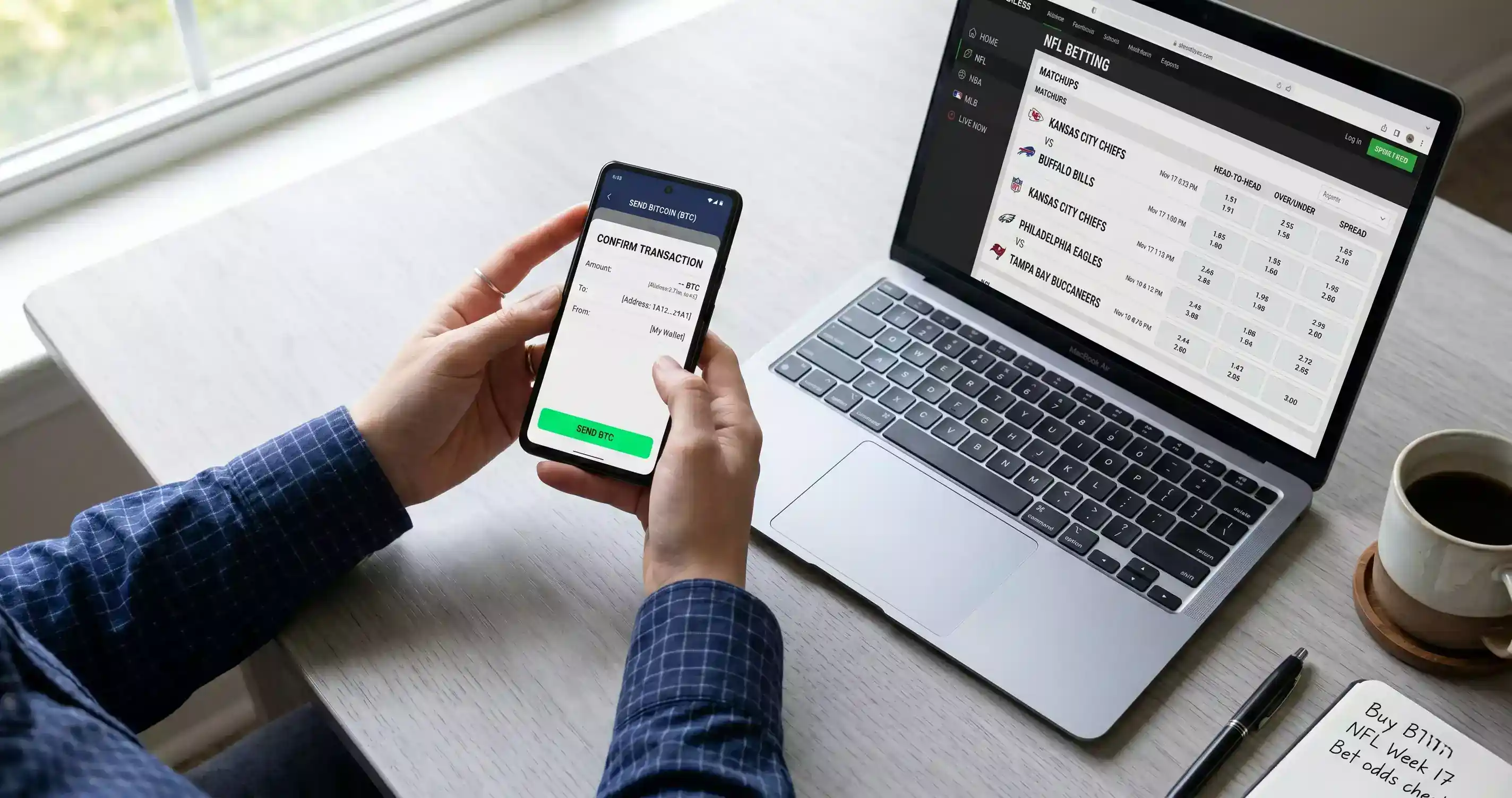
The practical difference for a UK bettor is speed and friction. Mobile betting accounts for 78% of all online sports wagers globally, and crypto sportsbooks are built for that reality. Depositing from a mobile wallet takes seconds; withdrawing winnings can clear within minutes rather than the two-to-five business days typical of bank transfers from traditional platforms. The trade-off is regulatory protection — a point I will return to in the section on UK regulation below.
Before You Place Your First NFL Crypto Bet
- Acquire cryptocurrency through a UK-accessible exchange (Coinbase, Kraken, Bitstamp, or similar). Make sure the exchange supports GBP deposits.
- Set up a personal crypto wallet — not the exchange wallet. A non-custodial wallet gives you control over your keys and a clean separation between your exchange account and your sportsbook.
- Research the sportsbook’s licensing jurisdiction. Curacao and Malta (MGA) are the most common. Neither is equivalent to a UKGC licence, but they represent different tiers of oversight.
- Check which cryptocurrencies and networks the sportsbook supports. Depositing USDT on the TRC-20 network is cheaper than on Ethereum mainnet, for instance.
- Understand the sportsbook’s KYC policy. Some require verification before your first withdrawal; others impose it only above a threshold.
- Verify that the platform covers NFL markets — spreads, moneylines, totals, props, and futures. Not every crypto sportsbook carries deep American football coverage.
- Set a bankroll limit in your reference currency (GBP) before converting to crypto. Crypto volatility can distort your sense of how much you are actually staking.
One detail that catches newcomers off guard: the odds format. UK bettors are accustomed to fractional odds (5/1) or decimal odds (6.00). American NFL odds are traditionally displayed in the moneyline format (+500 / -110). Most crypto sportsbooks default to decimal, which makes comparison easier, but it is worth checking. A misread odds format is the most avoidable mistake in cross-border betting, and I have seen experienced punters make it.
What Separates a Top-Tier Crypto NFL Sportsbook
I have tested over forty crypto sportsbooks since 2017. Some were excellent. Several were mediocre. A handful vanished overnight, taking deposited funds with them. That last category is why platform evaluation matters more in crypto than in any other corner of sports betting — there is no UKGC to claw back your money if an operator decides to disappear.
The criteria I use fall into three tiers.
Non-Negotiable: Licensing, Liquidity, and Payout History
The absence of any licence is a reliable signal of elevated risk. Curacao e-gaming licences are the industry’s lowest bar. The Malta Gaming Authority (MGA) imposes stricter rules around fund segregation, responsible gambling, and advertising. Neither equals a UKGC licence, but the MGA comes closer. Liquidity matters because a sportsbook that cannot cover large payouts will find reasons to delay withdrawals. Look for platforms that publish proof-of-reserves audits. Payout history is the most honest indicator — a platform operating for five-plus years without a pattern of disputed withdrawals is telling you something no marketing budget can fake.
Important: NFL Market Depth, Odds Quality, and Crypto Coverage
Not every crypto sportsbook treats the NFL the same way. Some offer a full slate — spreads, moneylines, totals, player props, game props, team props, futures from Super Bowl winner to Offensive Rookie of the Year — while others carry only the basics. Market depth matters because it determines how many angles you can work during a season. If you are interested in comparing odds quality across platforms, depth is the prerequisite.
Odds quality itself is a function of margins. The tighter the margin (also called the vig, juice, or overround), the more value reaches the bettor. Crypto sportsbooks generally operate with lower overheads than UKGC-licensed operators — no UK point-of-consumption tax, fewer compliance costs — and some pass that saving through in the form of tighter lines. Not all do. Comparing the same market across three or four platforms before placing a bet is a habit worth building.
Crypto coverage means which tokens and which networks the platform supports. A sportsbook that accepts BTC, ETH, LTC, and USDT covers the essentials. One that also supports SOL, TRX, DOGE, and multiple stablecoin networks (ERC-20, TRC-20, BEP-20) gives you flexibility to choose the cheapest and fastest deposit route for each transaction.
Nice-to-Have: Live Streaming, Cash-Out, and Promotional Depth
Live streaming of NFL games within the sportsbook interface is rare on crypto platforms but valuable for in-play betting. Cash-out features are more common and increasingly standard. Promotional depth goes beyond the welcome bonus headline — a 300% deposit match with a 40x rollover requirement on odds of 1.80 or higher may cost you more than it gives. The quality of a bonus lives in its terms, not its percentage, as I cover in the bonuses analysis.
Licensing Jurisdiction
Curacao offers baseline oversight; MGA provides stricter player protections. No crypto sportsbook currently holds a UKGC licence for crypto payments.
NFL Market Coverage
Full coverage means spreads, moneylines, totals, player/game/team props, futures, and in-play markets for every regular-season and playoff game.
Supported Cryptocurrencies
At minimum: BTC, ETH, LTC, USDT. Better platforms add SOL, TRX, USDC, and multiple network options for each token.
Platform evaluation is not a one-time exercise. I reassess every off-season, because operators that were solid in September can change ownership or exit markets by February. The habit that protects you most is maintaining accounts on two or three platforms, with the bulk of your bankroll in your own wallet.
Which Cryptocurrencies Work Best for NFL Bets
Not all crypto is created equal when it comes to placing NFL bets. I learned this the hard way during the 2021 playoffs, when I deposited Ethereum for a divisional round parlay and watched $14 in gas fees eat into a $200 stake. The bet won. The gas fees still annoyed me. Since then, I have been methodical about matching the right cryptocurrency to the right betting scenario, and the data supports what experience taught me.
Bitcoin dominates crypto gambling with approximately 66% of total volume. Ethereum sits second at 9%, Litecoin at 6%, and the rest is fragmented across dozens of altcoins. But those market-share numbers mask a tectonic shift happening underneath: stablecoins — USDT and USDC primarily — are the fastest-growing payment method in the sector and are projected to account for more than 70% of all crypto wagers by the end of 2026.
Bitcoin accounts for roughly 66% of all crypto gambling volume, but stablecoins are projected to handle over 70% of crypto wagers by the end of 2026 — a reversal that reflects bettors’ growing preference for price stability over speculative upside.
That reversal matters enormously for NFL bettors. Here is why: an NFL season runs from September to February. If you deposit one Bitcoin at the start of the season and bet with it across eighteen weeks of regular season and four rounds of playoffs, your effective bankroll fluctuates with two independent variables — your betting results and Bitcoin’s price. In a good scenario, both move in your favour. In a bad one, you win your bets but lose purchasing power because BTC dropped 20% over the winter. Stablecoins eliminate the second variable entirely. One USDT is pegged to one US dollar. Your bankroll tracks your betting performance and nothing else.
| Cryptocurrency | Share of Crypto Gambling | Primary Advantage | Primary Risk for NFL Bettors |
|---|---|---|---|
| Bitcoin (BTC) | ~66% | Widest acceptance, deepest liquidity | Price volatility over a multi-month NFL season |
| Ethereum (ETH) | ~9% | Smart contract ecosystem, growing Layer-2 options | Gas fees spike unpredictably, especially on mainnet |
| Litecoin (LTC) | ~6% | Faster block times than BTC, lower fees | Smaller ecosystem, fewer platform-specific bonuses |
| USDT (Tether) | Growing rapidly | Dollar-pegged stability, multiple network options | Counterparty risk tied to Tether’s reserves |
| USDC (Circle) | Growing | Regulated issuer, transparent reserves | Less widely accepted on offshore sportsbooks than USDT |
About half of all Bitcoin transactions are estimated to be gambling-related — a figure that underlines how deeply BTC and betting are intertwined. But intertwined does not mean optimal. For a UK bettor whose reference currency is GBP, the ideal setup is often a stablecoin for the bankroll and BTC or LTC only if you specifically want exposure to price movement alongside your wagers. David Wells, formerly Tether’s compliance chief, put it bluntly: “Offshore gaming will stick with USDT until a central-bank digital currency offers 24/7 finality.” The market agrees with him.
I explore the practical implications of this choice — including fee comparisons, network recommendations, and a worked example of a 500-pound bet across four different cryptos — in the dedicated Bitcoin vs. stablecoin analysis. For this section, the takeaway is simple: your choice of cryptocurrency is a strategic decision, not a default. Pick the one that matches your risk tolerance and your betting timeline.
Blockchain Networks Compared: Speed, Fees, and Finality
The cryptocurrency you choose is only half the equation. The network you send it on determines how much you pay in fees and how long you wait for your deposit to arrive. I once sent USDT to a sportsbook using the Ethereum mainnet during a period of high network congestion. The gas fee was $38 on a $300 deposit. The same transfer on the TRC-20 network would have cost under $1. Same token. Same destination. Thirty-seven dollars of difference because I picked the wrong rail.
This is the kind of detail that most crypto betting guides gloss over with a sentence like “crypto is faster and cheaper than bank transfers.” That claim is true in aggregate and misleading in practice. Speed and cost depend entirely on which blockchain network you use, and the differences are dramatic.
| Network | Typical Confirmation Time | Typical Fee Range | Best For |
|---|---|---|---|
| Bitcoin (on-chain) | 10-60 minutes (1-6 confirmations) | $1-$15 depending on congestion | Large deposits where security matters most |
| Lightning Network (BTC Layer-2) | Near-instant (seconds) | Under $0.01 | Small to medium deposits, time-sensitive funding |
| Ethereum (mainnet) | 1-5 minutes | $2-$50+ depending on gas prices | Avoid for routine deposits; use Layer-2 instead |
| TRC-20 (Tron) | Under 1 minute | Under $1 | USDT deposits — fastest and cheapest common option |
| Solana (SOL) | Under 1 second (finality ~12 seconds) | Under $0.01 | Speed-critical deposits, growing sportsbook support |
For NFL bettors in the UK, the practical recommendation depends on timing. If you are funding your account hours before a Sunday slate — comfortably, with no rush — on-chain Bitcoin or Ethereum mainnet will serve you fine. The fees are manageable for larger deposits, and the security of a fully confirmed on-chain transaction is unmatched. But if you are topping up your balance because you spot value in a Thursday Night Football line that is moving, you need the Lightning Network, TRC-20, or Solana. Waiting forty minutes for a Bitcoin confirmation while the spread shifts from -3 to -4.5 is not a theoretical problem — it is a weekly reality during NFL season.
| Scenario | Network Choice | Fee | Arrival Time | Outcome |
|---|---|---|---|---|
| Pre-game deposit, 200 USDT, Sunday morning | TRC-20 | $0.50 | 45 seconds | Funds available well before kickoff |
| Same deposit, Ethereum mainnet | ERC-20 | $8-$25 | 2-4 minutes | Funds arrive but fees reduce effective stake |
| Mid-week top-up, 0.01 BTC | Lightning | Less than $0.01 | 3 seconds | Instant availability, ideal for line shopping |
The Lightning Network deserves special mention. This Layer-2 protocol processes BTC transactions off-chain in payment channels, settling to the main blockchain only when the channel closes. For bettors, that means near-instant Bitcoin deposits at negligible cost. Not all sportsbooks support it yet, and channel capacity limits can cause routing failures on larger amounts, but adoption has accelerated sharply through 2025 and into 2026.
As David Wells, formerly Tether’s compliance chief, put it: “Offshore gaming will stick with USDT until a central-bank digital currency offers 24/7 finality.” That explains why TRC-20 USDT has become the default deposit method — stablecoin predictability, sub-dollar fees, near-instant settlement. For NFL betting, where you fund and withdraw multiple times across a season, the cumulative fee savings of choosing the right network amount to hundreds of pounds.
Crypto Network & Bonus Toolkit
Three calculators for crypto NFL bettors: compare deposit networks by fee and speed, work out what a bonus rollover actually demands, and see how much network choice costs you across a full season.
Enter a deposit amount and see the fee and arrival time across five common networks side by side.
Deposit bonuses come with a wagering (rollover) requirement. This shows the actual turnover you must generate before you can withdraw anything, and roughly how many bets that takes.
A season means many deposits and withdrawals. Pick two networks and see how much the fee difference adds up to over the season.
Fee figures are representative midpoints of the typical ranges each network charges — actual fees vary with network congestion at the time of transfer.
Speed and fees shape the deposit experience, but the regulatory environment shapes everything else. What does the UK’s gambling regulator actually say about crypto?
UK Regulatory Landscape: What UKGC Says About Crypto
If you had asked me in early 2025 whether the UKGC would ever allow crypto payments at licensed sportsbooks, I would have said “not in this decade.” The regulator’s stance was clear, consistent, and emphatically negative. Then two speeches changed the conversation entirely — and if you bet on the NFL with crypto from the UK, you need to understand what was said and what it means.
The current position is straightforward: UKGC-licensed operators are not permitted to accept cryptocurrency as a payment method. Full stop. That has been the rule for years, and it remains the rule as of mid-2026. Every crypto sportsbook that accepts UK bettors operates under a non-UK licence — typically Curacao, occasionally MGA — and falls outside the UKGC’s regulatory perimeter.
What changed is the direction of travel. In November 2025, Andrew Rhodes, CEO of the UK Gambling Commission, told a CEO briefing audience that crypto adoption among younger demographics was creating a pressure he could no longer dismiss. He was remarkably candid: “What I thought was a five-year-away problem, perhaps a year or two ago, I think is now an 18-month to two-year challenge.” He went further, warning that without a regulated pathway, an entire generation of crypto-native consumers would have “no place in legitimate industry because of the currency they use.”
“We do now want to start looking at what the potential path forward would be to create a way for cryptoasset to be used as a consumer payment option for licensed and regulated gambling in Great Britain.” — Tim Miller, Executive Director, UK Gambling Commission, February 2026

That quote from Tim Miller, delivered at the Betting and Gaming Council AGM three months after Rhodes’ speech, was the most significant shift in UKGC crypto policy to date. Miller acknowledged that crypto is one of the two biggest search terms leading British gamblers to illegal sites and framed innovation as a consumer protection tool: “There will be significant challenges and risks to overcome in considering this topic but I am keen that we approach this in the spirit of exploring the art of the possible rather than starting from a position of finding all the reasons not to innovate.”
FCA Timeline: The UK’s Financial Conduct Authority is implementing a comprehensive cryptoasset regulatory framework under the Financial Services and Markets Act 2000, expected to take effect on 25 October 2027. This framework will shape how the UKGC can integrate crypto into licensed gambling.
The illegal market figures add context to the urgency. Unlicensed online gambling now accounts for 9% of the UK’s online betting market — up from 2% in 2022 — representing approximately 379 million pounds in activity. The UKGC received 26 million pounds in additional Treasury funding to combat illegal operators, issuing 741 cease-and-desist notices and securing the removal of over 266,000 URLs in the 2025-2026 financial year alone. The growth of the illegal market and crypto’s role in driving traffic to unlicensed sites are directly connected — Rhodes and Miller both acknowledged as much.
For UK bettors, the practical reality is this: using a crypto sportsbook for NFL betting is not illegal for the individual consumer, but it carries risks that UKGC-licensed betting does not. You lose access to the GAMSTOP self-exclusion scheme, to ADR mechanisms, and to the regulatory backstop that ensures your funds are handled properly. The full regulatory analysis covers the legal nuances, the FCA timeline, and what consumer protections you forfeit when betting offshore.
The NFL’s Growing Footprint in Britain
I was at Tottenham Hotspur Stadium for a London Series game in October 2024. Eighty-three thousand people. A sold-out NFL crowd in North London, on a Sunday afternoon, watching two American teams play a sport that most Britons could not have explained twenty years ago. The atmosphere was electric, and the betting markets reflected it — lines on London games moved faster and more sharply than on equivalent fixtures played stateside, because the information asymmetry around travel fatigue, jet lag, and neutral-site dynamics creates genuine pricing inefficiency.
The UK’s NFL audience is small in absolute terms but growing at a rate that outpaces almost every other major sport in the country. Britain accounts for approximately 3% of global NFL fan traffic by search volume, and 10% of British consumers reported interest in the NFL as of the most recent YouGov data. London has hosted 39 International Series games since 2007, with 25 of the first 28 fixtures drawing at least 83,000 spectators.
The UK Super Bowl audience reached 3.7 million viewers in 2024 — a 10% increase in global non-US viewership. For context, that is larger than the average UK audience for a Premier League midweek fixture.

The demographic profile is what makes the NFL-crypto intersection so potent. A third of UK NFL viewers are under 35, compared to 17% of the US audience. That younger skew overlaps directly with the demographics driving crypto adoption — the 18-24 age group shows the highest growth rate among online gambling participants, and it is also the cohort most likely to hold cryptocurrency. Andrew Rhodes, the UKGC’s CEO, identified this overlap explicitly: “The growth in cryptocurrencies amongst younger demographics means that there is a pressure building within the system.”
For the crypto sportsbook industry, the UK NFL audience represents a compact but high-value segment: young, engaged, comfortable with digital currency, and watching a sport that generates more betting volume per game than any other. The 48% of UK adults who participated in some form of gambling in October 2025 represents the broader market; the fraction of that cohort interested in NFL and comfortable with crypto is the specific addressable market for platforms covered in this guide. It is not mass-market yet. But it is growing in every dimension that matters.
NFL Bet Types Available on Crypto Sportsbooks
The first NFL bet I ever placed was a moneyline on the Patriots. Simple, clean, boring. The first NFL bet I placed on a crypto sportsbook was a same-game parlay combining a spread, a player rushing prop, and a first-half total. Crypto platforms did not make me a more creative bettor — but the depth of their markets certainly enabled it. Here is a breakdown of what you can actually bet on.
Spreads and Moneylines
These are the bread and butter of NFL betting. The spread adds a handicap to equalise perceived mismatches; the moneyline is a straight-up win bet. On crypto sportsbooks, you will find spreads available from the moment lines open — usually Tuesday or Wednesday for the following week’s games — through to kickoff, with in-play spreads adjusting throughout.
| Market | Selection | Decimal Odds (Example) | Implied Probability |
|---|---|---|---|
| Spread | Team A -3.5 | 1.91 | 52.4% |
| Spread | Team B +3.5 | 1.91 | 52.4% |
| Moneyline | Team A to win | 1.57 | 63.7% |
| Moneyline | Team B to win | 2.45 | 40.8% |
The combined implied probability of any two-outcome market exceeds 100% — the gap is the sportsbook’s margin. In the spread example above, both sides at 1.91 yield a combined 104.8%, meaning the book’s overround is 4.8%. Crypto sportsbooks often operate at slightly lower overrounds than UK-licensed operators, though this varies by platform and by market.
Totals, Props, and Futures
Totals — the over/under on combined points — are the third pillar of NFL wagering. Player props (rushing yards, passing touchdowns, receptions) and game props (first score method, halftime leader, total sacks) are where crypto sportsbooks increasingly differentiate themselves. Some offer hundreds of prop markets per game, rivalling or exceeding the depth available on mainstream UK platforms.
Parlay — a single bet combining two or more selections. All legs must win for the parlay to pay. The payout multiplies with each added leg, but so does the risk.
Teaser — a type of parlay where the bettor receives favourable point adjustments on spreads or totals in exchange for reduced odds. A six-point teaser on two NFL games, for instance, moves each spread six points in your favour.
Prop bet — a wager on a specific occurrence within a game that does not directly relate to the final outcome. Player props focus on individual performance; game props focus on in-game events.
Futures markets — Super Bowl winner, conference champions, MVP, division winners, season win totals — open months before the regular season begins. Crypto sportsbooks typically release futures earlier than traditional platforms and keep them open with more granular options throughout the season.
| Bet Type | Example | Typical Odds Range (Decimal) | Available In-Play? |
|---|---|---|---|
| Player rushing yards over/under | Running back over 79.5 yards | 1.83 – 1.95 | Yes, on most platforms |
| First touchdown scorer | Wide receiver to score first | 6.00 – 15.00 | Pre-game only |
| Super Bowl winner (future) | Any team pre-season | 4.00 – 150.00+ | N/A |
Live betting deserves its own note: in-play wagering accounts for 53.4% of all online betting activity as of early 2026, growing at a projected CAGR of nearly 15%. For NFL, live markets typically include adjusted spreads, moneylines, totals, next scoring play, and drive-result props. The interaction between blockchain confirmation times and rapidly shifting live odds creates a unique dynamic covered in the live betting analysis.
Security, Licensing, and Protecting Your Bankroll
Every crypto sportsbook’s “About” page claims to be secure. Every one of them mentions SSL encryption and two-factor authentication as if those two features represent the summit of digital protection rather than the bare minimum. I have seen operators tout “military-grade security” while storing user funds in a hot wallet with a single private key. The gap between marketing language and actual security architecture is wider in crypto gambling than in almost any other sector I cover.
Here is what actually matters.
Cold storage — holding the majority of funds in offline wallets disconnected from the internet — is the single most important security feature a crypto sportsbook can offer. A platform that keeps 95% of deposits in cold storage is fundamentally more resilient to hacking than one that keeps all funds online for “instant processing.” Whether the platform publishes proof-of-reserves audits is another telling indicator.
Two-factor authentication is non-negotiable. Withdrawal whitelisting — the ability to restrict withdrawals to pre-approved wallet addresses, with a time delay before new addresses become active — adds a layer that most users overlook until they need it. Session management controls (automatic logout, device tracking, login notifications) round out the account-level protections worth enabling.
The UKGC issued 741 cease-and-desist notices against illegal operators and secured the removal of over 266,000 URLs in the 2025-2026 financial year. While this enforcement activity targets the supply side, it underscores the volume of unlicensed platforms operating in or targeting the UK market — and the importance of evaluating each platform’s legitimacy independently.
Chris Elliot, a partner at London law firm Wiggin who specialises in gambling regulation, offered a nuanced take on crypto’s security profile: “Like any new payment method, it will introduce new fraud/AML typologies. But ‘new’ doesn’t automatically mean ‘higher’. In some respects, crypto can support a more robust control environment than fiat payments, particularly where cash is involved.” That assessment captures the duality: crypto introduces different risks, not necessarily greater ones, and the blockchain’s transparency can actually aid compliance when platforms choose to leverage it.
Security on crypto sportsbooks is not a checkbox — it is a spectrum. Cold storage, proof of reserves, 2FA, withdrawal whitelisting, and licensing jurisdiction collectively determine how exposed your funds are. Evaluate each factor independently, and keep the bulk of your crypto in your own wallet rather than on any platform’s balance sheet.
The licensing dimension ties directly into security. A Curacao-licensed operator has fewer regulatory obligations around fund segregation than an MGA-licensed one, and neither matches the UKGC’s requirements. The practical implication: if a crypto sportsbook holding your NFL winnings becomes insolvent, your recourse depends almost entirely on the jurisdiction’s recovery framework. Under Curacao, that framework is minimal. Under MGA, it is more structured. Under no licence at all, it is effectively nonexistent.
Your First NFL Crypto Bet: A Step-by-Step Walkthrough
When I guide someone through their first crypto NFL bet, I always tell them the same thing: the process feels complicated right up until the moment you do it, and then it feels obvious. The entire sequence — from zero crypto to a placed wager — takes under an hour the first time and under five minutes every time after that.
What follows is the essential path. I am keeping this deliberately concise because the detailed version, covering exchange selection, wallet setup, and withdrawal strategies, lives in its own dedicated guide. This is the overview, not the manual.
Step 1: Acquire Cryptocurrency
Open an account at a UK-accessible crypto exchange, complete KYC verification, deposit GBP, and buy your chosen token. USDT on TRC-20 is the most practical default for beginners — no volatility, minimal fees.
Step 2: Set Up a Personal Wallet
Transfer crypto from the exchange to a non-custodial wallet. This creates separation between your exchange account and your betting activity and ensures you hold your own keys.
Step 3: Choose and Register at a Crypto Sportsbook
Select a platform based on licensing, NFL market depth, supported cryptos, and payout history. Registration typically takes under two minutes.
Step 4: Deposit Crypto
Copy the deposit address from the sportsbook’s deposit page, send funds from your wallet, and double-check the network. Sending TRC-20 USDT to an ERC-20 address results in lost funds.
Step 5: Place Your Bet
Find the NFL section, select your game and market, enter your stake, and confirm.
Step 6: Withdraw Your Winnings
Enter your wallet address, select the network, and confirm. Processing ranges from instant to twenty-four hours depending on the platform. Larger withdrawals may trigger KYC.
Quick-Reference Checklist for Your First Crypto NFL Bet
- GBP deposited at a UK-accessible crypto exchange
- Crypto purchased (USDT on TRC-20 recommended for beginners)
- Personal wallet set up and funded
- Sportsbook selected and account created
- Deposit address verified (correct network confirmed)
- NFL market selected — understand the bet type before staking
- Stake sized according to bankroll limits set in advance
- Withdrawal wallet address saved for post-bet cashout
The most common mistake I see from first-time crypto bettors is not the technical process — it is skipping the bankroll step. Setting a limit in GBP terms before you convert to crypto is essential, because the abstraction of betting in USDT or satoshis can detach you from the real-money value at stake. Write down a number in pounds. Convert that number. Bet with that number. Do not top up mid-session on impulse.
Frequently Asked Questions
Is it legal to bet on the NFL with crypto in the UK?
There is no UK law that criminalises individuals for placing bets on offshore crypto sportsbooks. However, these platforms operate outside the UKGC’s regulatory framework, which means you do not benefit from the consumer protections — self-exclusion schemes, fund segregation, dispute resolution — that UKGC-licensed operators must provide. The legality of the platform itself depends on its licensing jurisdiction. Using an unlicensed sportsbook carries higher risk, though the legal exposure falls primarily on the operator, not the bettor.
What are the best cryptocurrencies for NFL betting?
For most UK bettors, USDT on the TRC-20 network offers the best combination of price stability, low fees, and fast settlement. Bitcoin remains the most widely accepted cryptocurrency on sportsbooks but introduces volatility risk over a multi-month NFL season. Litecoin provides a middle ground with faster confirmation times and lower fees than on-chain BTC. Ethereum works well for larger deposits via Layer-2 networks like Arbitrum or Base, though mainnet gas fees can be prohibitive for smaller stakes.
How do I deposit Bitcoin at an NFL betting site?
Navigate to the sportsbook’s deposit section, select Bitcoin, and copy the deposit address provided. Open your personal Bitcoin wallet, paste the address, enter the amount, and confirm the transaction. On-chain deposits typically require one to three confirmations, taking anywhere from ten minutes to an hour. If the sportsbook supports the Lightning Network, select that option for near-instant deposits at negligible fees. Always verify that the deposit address matches the correct network before sending.
What is the difference between betting with Bitcoin vs. stablecoins like USDT?
Bitcoin’s price fluctuates against GBP and USD, meaning your bankroll’s purchasing power changes independently of your betting results. If you deposit 0.1 BTC and win your bets, but BTC drops 15% over the season, your net position in pound terms may still be negative. USDT is pegged to the US dollar, so your balance only changes based on your wagers. The trade-off is that you forgo any upside from Bitcoin price appreciation. For most bettors focused on NFL performance rather than crypto speculation, stablecoins offer cleaner bankroll management.
Are crypto NFL betting sites safe and licensed?
Safety varies dramatically. Some crypto sportsbooks hold MGA licences with meaningful compliance standards; others operate under Curacao e-gaming licences with less oversight; a minority hold no licence at all. Check licensing documentation, look for proof-of-reserves audits, review withdrawal history in community forums, and enable two-factor authentication and withdrawal whitelisting.
What types of NFL bets can I place with cryptocurrency?
Crypto sportsbooks generally offer moneylines, point spreads, totals, player and game props, parlays, teasers, and futures including Super Bowl winner and MVP. Many also carry live in-play markets with dynamically adjusting odds. Market depth varies by platform — some offer hundreds of props per game, while others focus on core markets.
How fast are crypto withdrawals from NFL betting sites?
Speed depends on the sportsbook’s processing time and the blockchain network. Some platforms release withdrawals automatically within minutes; others impose reviews of two to twenty-four hours. Once released, Lightning and TRC-20 settle in seconds, on-chain Bitcoin takes thirty to sixty minutes, and Ethereum mainnet varies with gas. First-time or large cashouts may trigger KYC verification.
Where Data Meets the Decision
Nine years of analysing this space have taught me one thing above all: the crypto NFL betting market rewards informed bettors and punishes lazy ones more severely than any traditional equivalent. The absence of a UKGC safety net means your platform choice, your cryptocurrency choice, and your understanding of the regulatory landscape are not preferences — they are risk management decisions with real financial consequences.
The market is not slowing down. An $81 billion crypto gambling sector, an NFL that draws 124.9 million Super Bowl viewers, and a UK regulator openly discussing “the art of the possible” for crypto payments — these are the current state of play, not speculative trends. What remains uncertain is the timeline. The FCA’s cryptoasset framework arrives in October 2027; the UKGC’s path from exploratory language to actual policy may take longer. Between now and then, UK bettors combining crypto with NFL wagering will continue to operate in a regulatory grey zone that demands more diligence, not less.
The data in this guide is current as of the 2026 season and will be updated as regulations shift and platforms evolve. If you take one principle from this analysis, make it this: in a market where the technology moves faster than the rules, your best protection is understanding both.
Crypto NFL betting from the UK is viable, growing, and increasingly data-rich — but it demands more from you than traditional betting. Choose your cryptocurrency for stability unless you deliberately want volatility exposure. Evaluate platforms on licensing, payout history, and security architecture rather than bonus headlines. And stay informed about the UKGC’s evolving position, because the regulatory landscape in 2027 will look very different from today.
Created by the ”Best nfl Crypto Betting” editorial team.